Everyday care 6 min read
A small-budget enrichment plan you can reuse
Make a simple rotation of enjoyable activities for your dog or cat using suitable things you already have, thoughtful supervision and a small amount of planning.

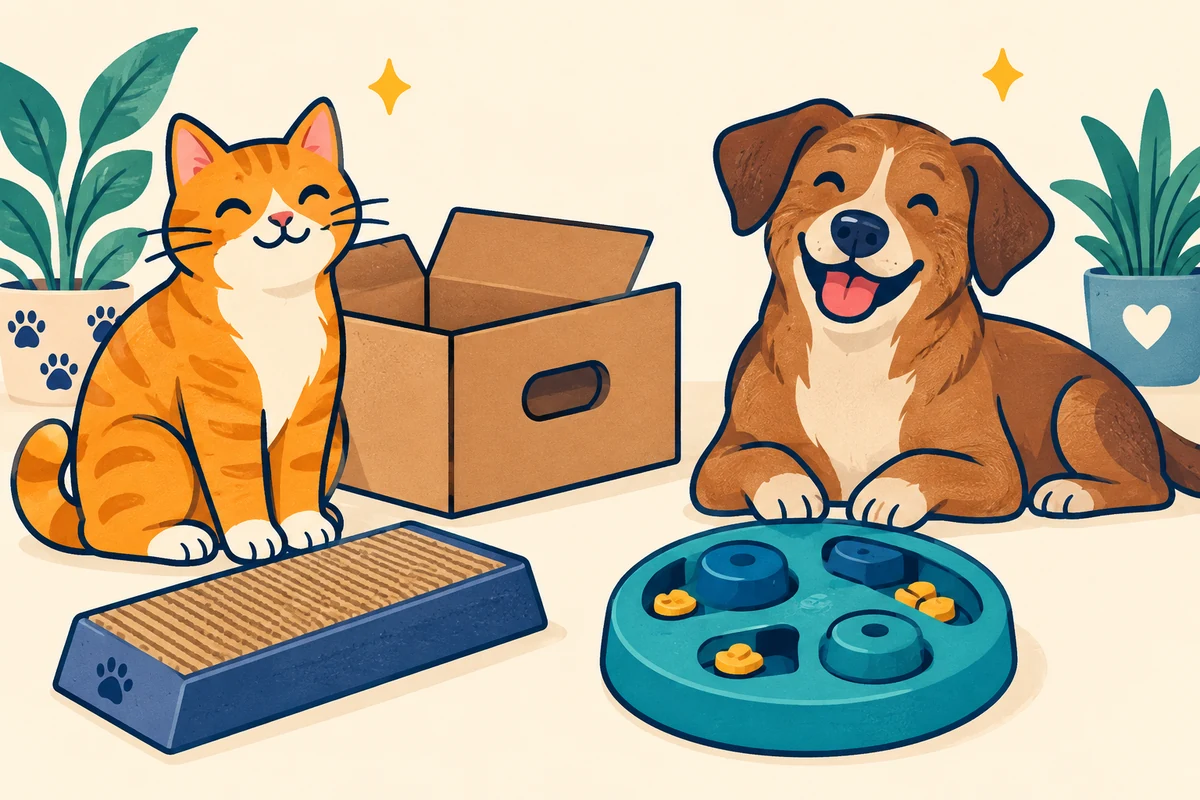
A cupboard full of toys does not tell you which activities your pet enjoys. Before buying the next puzzle, look at what already gets a voluntary sniff, a relaxed investigation or an invitation to play. You may have the beginnings of a useful rotation at home.
This is a way to organize modest spending, not a challenge to make every pet item yourself. Start with suitable things you own, leave out anything damaged or unsafe, and buy only when you can describe the need it will meet. The activity should fit the animal, rather than the animal having to perform for a clever idea.
The short version
Key takeaways
- Keep a short list of activities your pet actually chooses to enjoy.
- Rotate suitable toys and opportunities instead of constantly buying more.
- Supervise new activities and check materials for wear or swallowing hazards.
- Keep food games within the pet's usual appropriate feeding plan.
Start with a small inventory
Set out the toys and useful items you already have. Sort them into three groups: ready to use, needs attention, and no longer suitable. Do not put something back into rotation merely because it was expensive. Keep the list short enough that checking and storing it is easy.
Beside each usable item, write what your pet seems to enjoy doing with it. A dog may like finding one familiar toy; a cat may choose a box more often than the toy that arrived inside it. These are your own observations, not a test the animal has to pass. Add free activities, such as a chance to investigate safe smells, alongside objects.
Further reading: Dogs Trust: Enrichment activities for dogs (opens in a new tab); Cats Protection: Cats and Play (opens in a new tab)
Keep the safety and feeding plan attached to the idea
A free object is useful only if it is suitable. Check size, condition and materials; skip sharp edges, loose small parts or an item your pet is likely to swallow. The RSPCA recommends safe, non-toxic dog toys appropriate for play. Buying a suitable item can be a better choice than repeatedly trying to adapt unsuitable scrap.
For cat food puzzles, Cats Protection advises using food from the normal weighed allowance. Keep the same principle in your notes: food used in a game is still food. If you are unsure whether an activity or ingredient fits an individual medical or feeding plan, ask your veterinary team before trying it.
Further reading: RSPCA: Creating a Good Home For Your Dog (opens in a new tab); Cats Protection: Cat food puzzles (opens in a new tab)
Spend after you can name the gap
Before a purchase, finish this sentence: this will help my pet do something they currently cannot do comfortably. Perhaps you need a suitable scratching surface, an easier-to-clean feeder or a safe replacement for a worn toy. That is a clearer reason than buying an entire matching collection because it looks appealing.
Also account for the effort an item needs. Consider storage, cleaning, supervision and replacement parts, not just the price on the shelf. Keep one or two useful options easy to reach and store the rest safely. A simple rotation is easier to keep up when it fits your home as well as your budget.
Leave room for rest and changing preferences
The aim is a more enjoyable day, not constant activity. A pet may choose differently from one session to another. Finish comfortably, retain the favorites and set aside ideas that repeatedly need coaxing. An unused toy is information about your next choice, not a failure.
Our everyday enrichment guide explains the broader ideas behind sniffing, play and learning. This small-budget plan simply helps you keep track of useful options. It does not replace exercise, rest or necessary care, and a new health or behavior concern should not be treated as a shopping problem.
Further reading: Dogs Trust: Enrichment activities for dogs (opens in a new tab)
A few more things to know
Frequently asked questions
Does every enrichment activity need food?
No. Appropriate sniffing, play or a familiar-toy search can work without food.
Can I leave a cardboard toy out all day?
Supervise new items. Remove anything the animal tears into swallowable pieces or could become tangled in.
Should the games get harder every day?
No. Repeat enjoyable favorites and simplify frustrating activities; difficulty is not the goal.
How do I know what is worth buying next?
Use your notes to identify a specific gap or a worn item that needs replacing. Compare suitability, cleaning, storage and supervision as well as price. You may find that rearranging or rotating what you already own is enough.
Sources & further reading
Explore the guidance behind this article.
Thoughtful reads for people who want animals to feel safe, comfortable, and loved. These guides share general information; your veterinarian can advise on your animal’s individual health needs.